
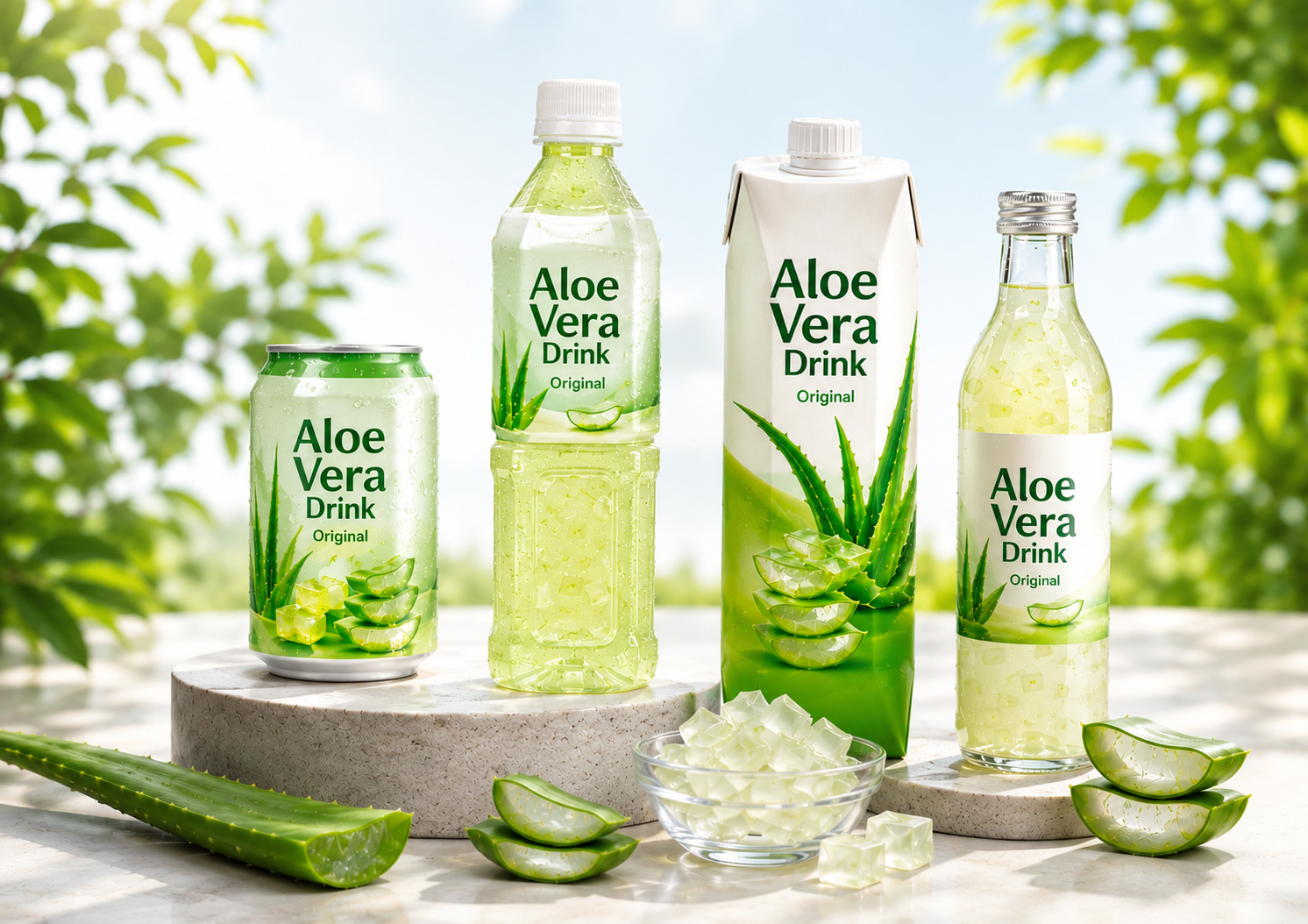
Aluminum cans, PET bottles and glass bottles can all be considered for an aloe vera drink. The best option depends on the actual beverage, especially whether it contains aloe pieces, how those pieces are filled, whether shoppers need to see them, and which processing and storage conditions the finished pack must withstand. Choose a product–package–process combination, not just a container that looks right on the shelf.
For an importer or brand owner, the practical starting point is a short technical brief. That brief should define the aloe ingredient and its texture, the desired consumer experience, the distribution route and the evidence needed before production. The packaging decision becomes much clearer once those inputs are agreed.
First define the aloe drink you are packaging
A clear aloe-flavoured beverage and an aloe drink with visible gel pieces can require different handling. Even within a drink containing pieces, variation in particle dimensions and loading can change the filling challenge.
Record the following before requesting packaging samples:
- Product identity: a flavoured drink, an aloe drink with gel pieces, or another clearly defined formulation. Use a precise product description for the destination market rather than assuming that every aloe beverage qualifies as juice.
- Aloe inclusions: approximate size range, shape and distribution target for pieces, and the finished-drink texture the buyer expects.
- Formula and storage target: the approved formula version, relevant acidity and stability data, whether chilled or ambient distribution is intended, and the target shelf life requiring validation.
- Retail use: single-serve or shareable presentation, resealing needs, whether the pieces themselves must be visible, and target sales channel.
- Export logistics: secondary packaging, route and handling risks, retailer case requirements and the destination market's labelling needs.
The final formula and its processing route need to be assessed by qualified technical personnel. Packaging material alone does not establish microbiological safety or a defensible shelf-life claim.
Cans vs PET bottles vs glass: a buyer decision matrix
Decision factor | Aluminum can | PET bottle | Glass bottle |
|---|---|---|---|
Seeing aloe pieces before opening | Opaque, so the drink is not visible | Clear PET can show texture and suspended pieces | Clear glass can show the product, while tinted glass changes visibility |
Closing after opening | Generally not resealable in a standard beverage-can format | A suitable screw closure can make the pack resealable | Resealability depends on the selected closure |
Light exposure | The metal container is opaque | Clear bottles transmit light unless protection is designed in | Clear glass transmits light, with transmission affected by glass colour |
Oxygen and package barrier | Assess can lining, seaming and the complete sealed system | Depends on bottle construction, closure and any barrier features | The glass body is impermeable, but the closure and seal still matter |
Handling aloe pieces | Filling method, piece size and drinking opening must be checked | Filling method, piece size, neck opening and cap must be checked | Filling method, neck opening and closure must be checked |
Production route | Must match a validated can-filling, closing and processing system | Must match a validated bottle, cap, filling and processing system | Must match a validated glass-container, closure and processing system |
Export handling | Check seam integrity, dents and secondary packaging | Check deformation, cap integrity and transport performance | Check breakage, weight, partitions and secondary packaging |
Primary buying question | Can this can, lining and seaming process handle the exact product? | Can this PET bottle and closure handle the product and process? | Can the glass bottle, finish, closure and distribution plan be qualified? |
This table compares engineering considerations rather than guaranteeing performance. A buyer should not assign a universal “best” label, shelf life or cost ranking to any of the three materials.
PET bottles: where product visibility is important
A clear PET bottle lets shoppers inspect the beverage's appearance. For aloe drinks with visible pieces, this may be useful if the brand wants the product texture to participate in its shelf presentation. A screw-cap design may also suit a brief requiring resealing after opening.
Those advantages need to be checked against processing and barrier performance. A PET bottle suitable for one filling route is not automatically suitable for every hot-fill or aseptic process. For example, Sidel's heat-resistant PET packaging work describes purpose-designed PET geometry for hot-filled beverages. That example demonstrates why the bottle and filling method must be developed together. It does not prove that a standard PET bottle or any particular factory line is suitable for an aloe formulation.
Before approving PET, request a sample filled with the target drink and ask about:
- Bottle and cap specifications, including neck finish and tamper evidence
- Processing compatibility of the actual bottle design
- Distribution of aloe pieces during filling and after transport
- Product stability, oxygen/light sensitivity and relevant pack tests
- Case packing, leakage performance and any temperature-related distortion
Choose PET as a candidate when visibility or resealing is valuable and the full package can be validated. Avoid treating its transparency as proof of quality, product authenticity or a fixed shelf-life advantage.
Aluminum cans: opaque packaging with specific closure checks
A can offers a different presentation: it hides the beverage until opened, which makes label artwork and accurate on-pack product depiction especially important when the drink contains aloe pieces. A standard can also does not provide the same resealing experience as a screw-cap bottle.

Technical qualification remains essential. The Can Manufacturers Institute's explanation of can manufacturing identifies protective internal coating and mechanical checks as part of can production. For an aloe beverage, buyers should therefore ask whether the chosen can body, internal coating, can end and seam are compatible with the formula and its validated processing route. They should not assume that an opaque metal pack automatically eliminates all shelf-life or packaging risks.
For a drink containing pieces, confirm that dosing is repeatable, that particles are not damaged or unevenly distributed, and that the drinking opening delivers the intended experience. These are project-specific questions, not universal claims that cans cannot accommodate pulp.
Choose a can as a candidate when an opaque, typically single-use format fits the channel and the supplier can substantiate the filled-can system. Do not assume a particular can size, lining type or filling capability is available before the manufacturer confirms it.
Glass bottles: visibility and material performance with freight considerations
Clear glass can display aloe pieces and may support a distinctive brand presentation. The glass body also has different material-barrier characteristics from plastic. The European Container Glass Federation describes glass as virtually inert and impermeable and explains that a complete glass pack also includes a separate closure.
That distinction matters. Glass does not make the whole filled package automatically suitable for a given thermal process, storage condition or shelf-life target. Closure compatibility, seal integrity, light exposure through the bottle, handling resistance and product tests still need to be established.
Compared with lightweight container choices, a glass project should pay particular attention to freight weight, impact protection, carton partitions and the cost of breakage. These are considerations to measure for the planned route, not grounds for a universal claim that glass is either the most premium or the least sustainable option.
Choose glass as a candidate if the commercial brief values a transparent glass presentation and the distribution and technical evidence support it.
Why aloe pieces make filling-line compatibility a deciding factor
When a drink includes soft solids, the filling system must handle more than the liquid portion. The manufacturer needs to consider piece size, variation, distribution, damage during handling and the product–container interface.
Equipment supplier GEA describes filling solutions for sensitive drinks containing pulp and fruit pieces, while its aseptic dosing example discusses ways to manage large soft solids. These are useful demonstrations of industry technology, not evidence that every beverage factory operates the same equipment.
For any shortlisted pack, ask the production team to demonstrate or document:
- Piece compatibility: can the proposed system handle the agreed particle dimensions without unacceptable damage or blockage?
- Dose consistency: how will the quantity and distribution of pieces be assessed across finished packs?
- Pack interface: do bottle neck, can opening, cap and filling configuration support the intended drinking experience?
- Process validation: what product-specific heat treatment, hygienic filling or other validated route is proposed?
- Acceptance evidence: what samples, process records and finished-pack tests support approval?
For a beverage with visible inclusions, the appropriate pack cannot be selected independently of those answers.
Match the pack to a sales channel without inventing regional preferences
Different channels impose different requirements, but a region name alone is not a reliable substitute for a buyer brief.
Buyer scenario | Candidate direction to evaluate | Evidence to request |
|---|---|---|
Retailer wants shoppers to see aloe pieces | Clear PET or clear glass | Filled shelf sample, appearance stability and closure suitability |
Convenience format prioritises a compact opaque pack | Can | Can size, coating/seam compatibility, can-opening experience |
Multi-occasion use requires resealing | Capped PET or glass | Closure performance and actual use conditions |
Long export route with several handling stages | Compare all qualified formats | Route-specific transit, case and breakage/leakage evidence |
Beverage has a high loading of large pieces | Start with process feasibility, not container preference | Particle-size specification, line trial and uniformity checks |

The scenarios are decision examples, not sales rankings or documented consumer preferences in Asia, Europe, the Middle East or North America. Use retailer requirements, physical samples and shipment evidence for the actual destination.
Packaging qualification: what to approve before artwork and orders
A selected container becomes a production-ready package only after the complete system has been evaluated. Use this checklist as a discussion aid with your beverage manufacturer and packaging specialist.
Approval item | Buyer should request |
|---|---|
Formula version | Approved product reference and the specified aloe-piece characteristics |
Primary pack | Material, nominal volume, bottle/can drawing and relevant supplier specification |
Closure or can end | Identified component, tamper-evidence approach and integrity requirements |
Filling/processing | Documented proposed route and appropriate technical validation |
Product and pack compatibility | Evidence covering interaction with product, filling conditions and storage |
Quality and shelf life | Product-specific test plan, proposed acceptance criteria and study conditions |
Distribution | Case configuration, pallet plan and transport-performance checks |
Artwork | Approved print dimensions, label market and claim review |
Change control | Named owner and approval process for new formula, pack or artwork versions |
Do not substitute a supplier brochure for the required product-specific validation. For shelf life in particular, the drink, filled pack, storage conditions and test results need to be assessed together.
Example: an aloe drink packaging request a buyer can send
A practical first enquiry can be concise while still allowing an informed discussion:
Product: ready-to-drink aloe beverage with visible gel pieces.
Texture brief: target particle dimensions and indicative loading to be confirmed by sample.
Target market: specify the country and retail channel.
Preferred options: transparent PET bottle and aluminum can for comparative feasibility review.
Storage goal: specify ambient or chilled distribution and proposed shelf-life objective.
Commercial brief: estimated launch quantity, expected repeat orders and secondary-pack requirements.
Evidence requested: available pack specifications, filled samples, processing compatibility, relevant quality tests and draft artwork requirements.
This is an illustrative RFQ, not a statement that either format has already been approved. A clearer brief helps the technical team identify which questions can be answered immediately and which require trials or updated specifications.
Frequently asked questions
Is PET always suitable for hot-filled aloe drinks?
No. PET bottle design, closure, product and filling process must be qualified together. Heat-resistant PET systems exist, but ordinary PET packaging should not be assumed to withstand a particular process.
Can an aluminum can hold an aloe drink with pieces?
Potentially. The buyer should confirm the particle-handling method, dosing uniformity, internal lining, can-end integrity and drinking opening with the selected manufacturer. The mere presence of aloe pieces does not prove or rule out can suitability.
Does glass automatically give an aloe drink a longer shelf life?
No. Glass-body barrier properties are only part of the package system. The closure, product formula, validated manufacturing process, storage conditions and finished-product evidence determine what shelf life can responsibly be claimed.
Discuss packaging feasibility with Nam Viet Group
For a broader packaging shortlist, explore Nam Viet Group's beverage packaging formats and prepare product-specific questions using the filling and packaging line guide. These pages introduce options and review requirements, not confirmed aloe-product compatibility.
If you are evaluating an aloe beverage manufacturing project, send the formula brief, proposed aloe-piece specification, target country, pack options and intended distribution conditions to Nam Viet Group's business team. These details enable a focused discussion of available options, technical checks and the evidence required before a packaging decision is finalised.