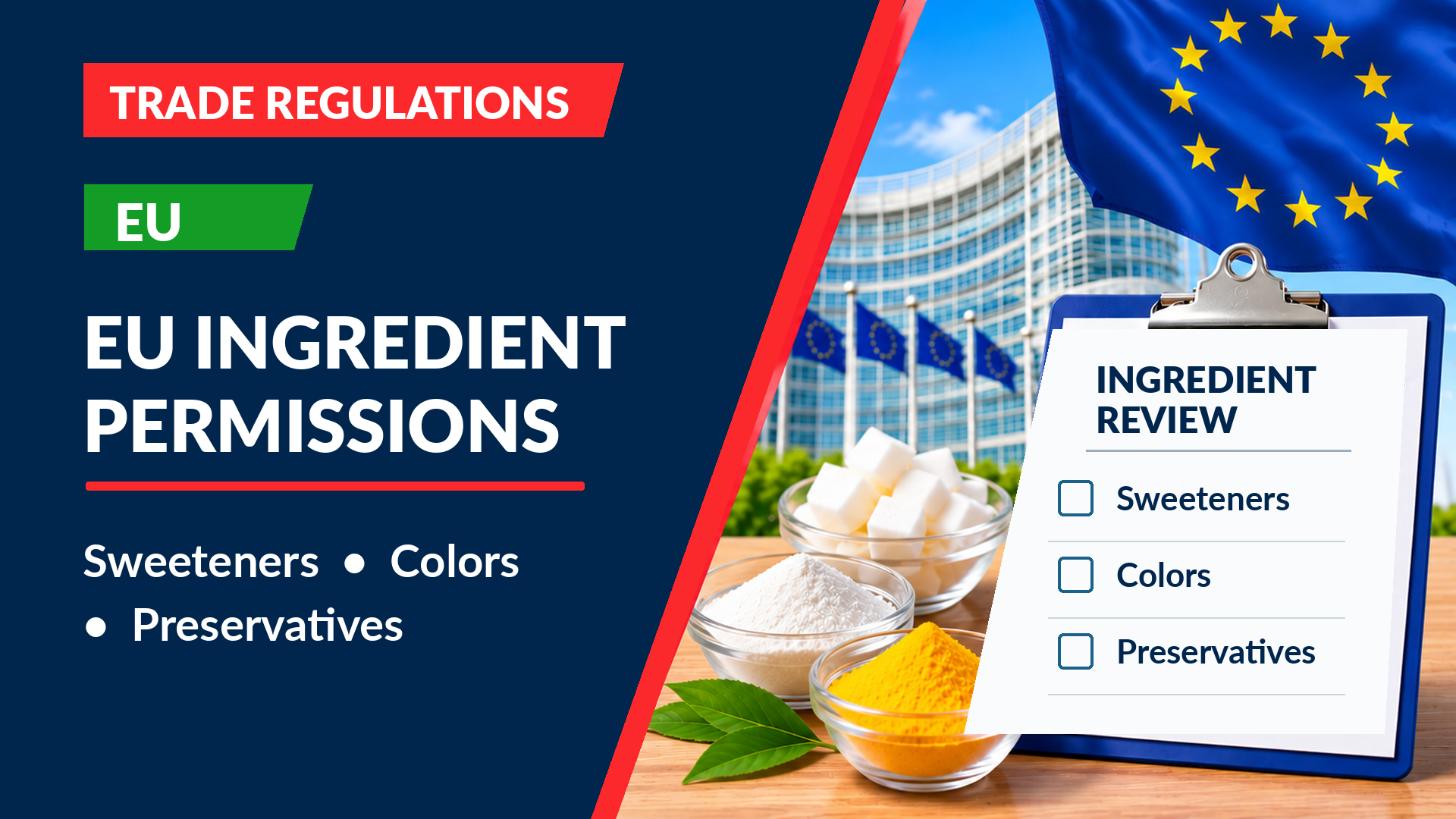
For beverages manufactured in Vietnam and sold in the European Union (EU), an additive is not permitted simply because its E-number appears on an approved list. The EU importer and manufacturer must classify the drink, check each additive's permitted use and verify the label. This guide addresses EU destination rules, not Vietnamese export formalities.
1. Classify the finished beverage before checking additives
EU Regulation (EC) No 1333/2008 uses food categories to determine where each additive may be used. Juice, nectar, flavoured soda and tea can face different permissions. Classify by formulation, not marketing name. Annex II, Part D
Beverage being assessed | EU additive-category starting point |
|---|---|
Fruit or vegetable juice meeting the relevant definition | 14.1.2 |
Fruit or vegetable nectar and similar products | 14.1.3 |
Flavoured carbonated drinks and many formulated aloe or boba drinks | 14.1.4, subject to product classification |
Tea, coffee and infusions within the specific category | 14.1.5 and its subcategories |
Commission guidance distinguishes a tea-flavoured soft drink from a tea infusion. This guidance is nonbinding. Commission food-category guidance
2. Verify each sweetener, preservative and colour against the right category
For each additive, record its function, E-number, purpose and finished-drink concentration. Use the European Commission additives database to find the entry, then cross-check Annex II, Part E of Regulation 1333/2008 for the relevant category. An additive authorised in category 14.1.4 cannot be assumed authorised in 14.1.2 or 14.1.5. EU additive rules
Check product-specific restrictions, exclusions and footnotes. Where the entry specifies a maximum, verify both its unit (for example, mg/L or mg/kg) and the rule for any combined additive group. Match calculations to the applicable ready-to-consume product. Annex II, Part E
Some entries use quantum satis instead of a numerical ceiling. That does not mean unrestricted use. It requires good manufacturing practice, no more than needed for the intended technological effect, and no misleading of the consumer. Category authorisation remains necessary. Regulation 1333/2008, Article 3
3. Examine compound ingredients, aloe pieces and boba components
A beverage can receive additives through syrups, flavourings, fruit preparations, aloe pieces or boba pearls. Obtain supplier compositions and contributed additive levels. Do not accept a component's compliance declaration as proof that its additives may perform the same function in the finished beverage.
Article 18 of Regulation 1333/2008 permits carry-over only under specified conditions. One important condition concerns whether the additive retains a technological function in the final food. Annex II also contains restrictions that can displace general assumptions about carry-over. Review the intended final use rather than treating every additive in a purchased ingredient as exempt. Article 18
Separately, additives in flavourings and certain other preparations can be subject to Annex III permissions and specifications. Obtain component data before formula sign-off. Commission explanation of Annex III
4. Check the label after the formula, not before
For retail ingredients, EU food-information rules generally require an additive's functional class followed by its specific name or E-number. Authorisation and labelling are separate checks. Regulation (EU) No 1169/2011, Annex VII, Part C
Under Annex III of Regulation 1169/2011, foods containing authorised sweeteners may need “with sweetener(s)” alongside the food name, or “with sugar(s) and sweetener(s)” when both added sugars and such sweeteners are present. The aspartame/phenylalanine wording depends on how aspartame is identified in the ingredient list. Foods with more than 10% added polyols have a separate laxative-effects statement. Warnings are conditional. Annex III
Regulation 1333/2008 Article 24 and Annex V impose an additional warning for foods containing certain specified colours, subject to the Annex's exceptions. Not every permitted colour triggers it. Review the specific colour and final label against the Annex, plus the language requirements for the EU Member State where the drink is sold. Food-colour labelling
5. Complete a pre-artwork approval record
For an EU buyer:
- Fix the exact formula, intended EU Member State and category for each beverage variation.
- Obtain supplier specifications for additives in the drink and its compound ingredients.
- Create an E-number-by-category matrix with the applicable limits, units and footnotes.
- Reconcile the proposed dose and supporting calculations with the finished product.
- Check functional-class declarations and any triggered sweetener or colour warnings.
- Ask the EU importer to confirm the final product classification and destination-language artwork.
Request product specifications for your target market from Nam Viet Group. Share the beverage concept, additive requirements, pack format and EU country to discuss specifications and documents with your importer.
This is a general EU additive-screening guide. It does not establish an authorisation, formulation approval or clearance for any individual product.
Frequently asked questions
Can an additive used in a flavoured soft drink also be used in 100% fruit juice?
Not automatically. Fruit juices and flavoured drinks appear in separate Annex II food categories, so permissions and limits must be checked independently. The name or E-number of an additive alone does not establish a permitted use. EU Annex II (https://eur-lex.europa.eu/eli/reg/2008/1333/2026-08-18/eng/pdf)
Are additives brought in through boba pearls or aloe pieces automatically exempt?
No. Article 18 contains conditional carry-over rules. Check whether the substance performs a technological function in the finished beverage and whether a category-specific restriction applies. Obtain complete specifications for each compound ingredient. Article 18 (https://eur-lex.europa.eu/eli/reg/2008/1333/2026-08-18/eng/pdf)
Does quantum satis mean a beverage manufacturer can use any amount?
No. Quantum satis means the additive must be used under good manufacturing practice at no more than needed for the intended effect, without misleading consumers. The additive must still be authorised for the relevant category and use. Regulation 1333/2008, Article 3 (https://eur-lex.europa.eu/eli/reg/2008/1333/2026-08-18/eng/pdf)