Import Beverages into Great Britain: GB Buyer Guide | Nam Viet Group
NAM VIET INSIGHTS
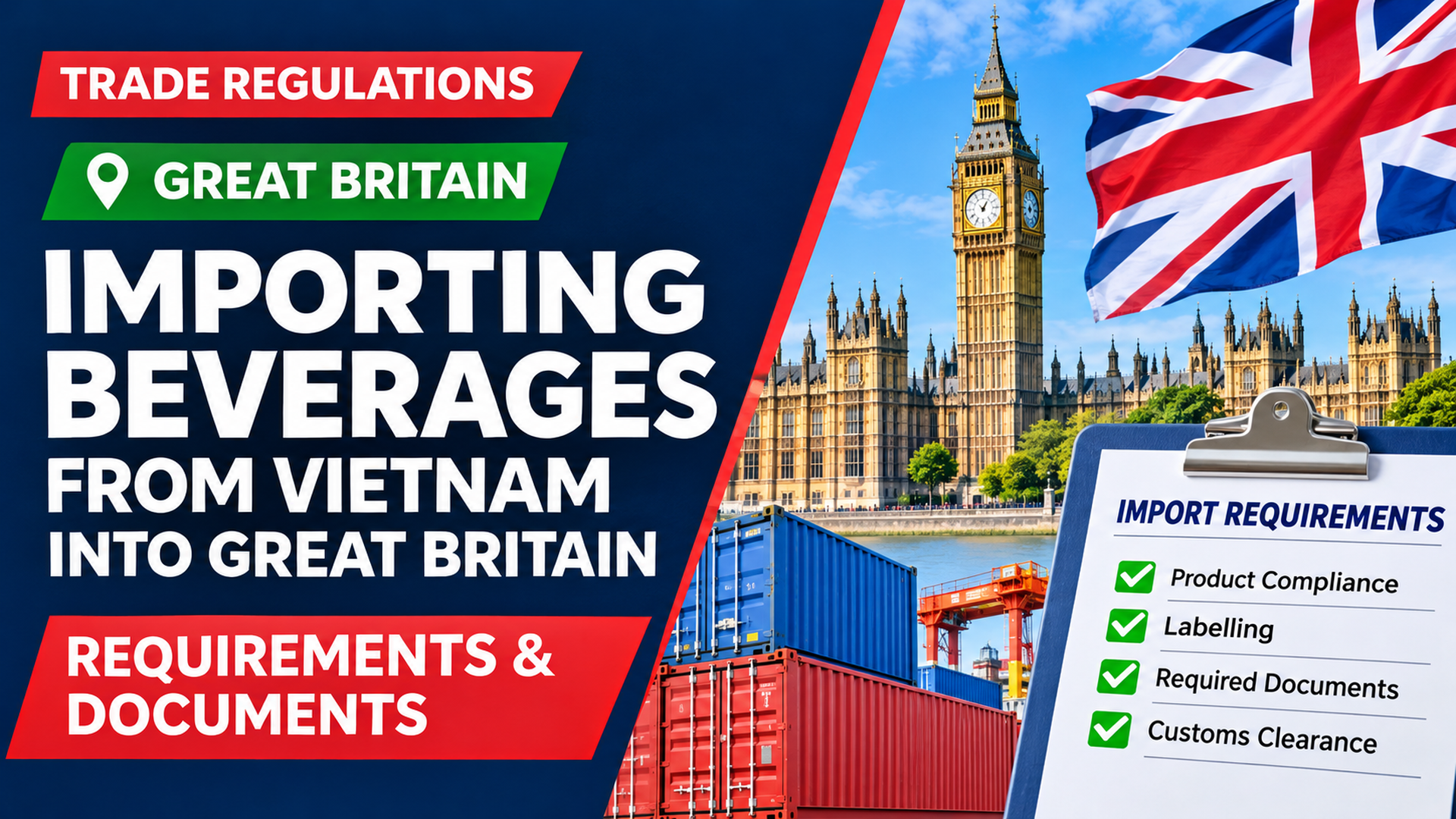
Importing Beverages from Vietnam into Great Britain: Requirements and Documents
A practical route for GB beverage buyers covering importer responsibilities, food controls, customs entry, UK labels, origin evidence and shipment documents.
5 min read
Commercial drinks shipped from Vietnam to Great Britain need a UK customs entry, compliant food information and a product-specific safety check before sale. The GB importer arranges customs and destination-market compliance, while the Vietnamese manufacturer supplies reliable specifications and shipment evidence. This guide covers England, Scotland and Wales, not Northern Ireland or the separate procedures for exporting from Vietnam.
Decide which import controls apply to the drink
Start with the finished formula and its intended use, not a broad description such as "tropical beverage." For ordinary non-animal-origin drinks, the Food Standards Agency (FSA) says equivalent food hygiene and compositional standards apply and a health certificate is not normally needed. Its importing drinks guidance is explicitly addressed to England and Wales, so confirm the corresponding position for a Scottish destination.
Milk, egg or other animal-derived components can change the route. Certain products of animal origin and composite products require additional checks, approved-country or establishment conditions, and possibly certificates. The importer should screen these branches using the Defra non-EU import guidance before selecting the port or ordering labels.
Assign the importer, customs agent and business registration
The UK buyer and exporter should agree who is the importer, who instructs the customs agent and who maintains food-business records. Businesses importing into England, Scotland or Wales generally require a GB-prefixed Economic Operators Registration and Identification (EORI) number. A broker may file the declaration, but representation terms still need agreement. See .
A UK business selling, storing, distributing or brokering food may need food-business registration with its local authority, including where it works from an office. The FSA registration guidance gives an advance-registration rule for England and Wales and points Scottish operators to separate arrangements. Registration of a UK buyer does not register the Vietnamese factory as a UK food business.
A separate safety and security entry summary declaration usually falls to the carrier, which may appoint an agent. It is not the same as the import customs declaration, and exemptions depend on the movement. The carrier should agree the responsible filer before dispatch under HMRC's entry summary guidance.
Screen product safety and border notification before shipping
Import controls depend on the actual ingredients, processing and commodity origin. For example, a shelf-stable fruit drink without animal-derived ingredients does not become a product of animal origin simply because it is packaged in a can. Conversely, adding dairy to ready-to-drink coffee requires a fresh assessment rather than copying the fruit-drink procedure.
The Import of Products, Animals, Food and Feed System (IPAFFS) covers specified controlled imports, including animal products, some composite foods and high-risk food and feed not of animal origin (HRFNAO). Ordinary bottled juice does not automatically require notification. Listed high-risk goods may need a Common Health Entry Document, a designated border post and, for some listings, laboratory evidence or a certificate.
The manufacturer should provide ingredient details, processing information, shelf-life rationale and relevant safety evidence. The importer determines whether those facts support the chosen GB import route, including any controls for novel ingredients, additives, contaminants or specific food categories. Do not treat the absence of a routine health certificate as a blanket safety approval.
Check GB retail labels before approving artwork
For a prepacked drink sold in GB, check its legal food name, ingredients, allergens, net quantity, applicable nutrition information, date and lot details, storage instructions and origin information when required. The address of the responsible food business operator (FBO), or the UK importer where applicable, must meet GB requirements. An email address alone does not replace the physical business address. See Defra and FSA food-labelling guidance.
Product names carry their own rules. Fruit juice and nectar descriptions have compositional standards, while fortified drinks and products making nutrition or health claims need further checks. Do not assume EU artwork automatically meets GB rules or that Northern Ireland's address rules are identical. Check the government's fruit-juice composition guidance when approving a juice label.
Calculate customs duty, preference and possible soft-drink levy
The importer or customs agent must select the UK commodity code from the actual recipe and product characteristics, then review tariff duty, value-added tax (VAT) and import restrictions in the UK Trade Tariff. Do not reuse a Vietnamese tariff code as a complete GB classification or assume every beverage carries the same rate.
Vietnam and the UK trade under both the UK–Vietnam Free Trade Agreement (UKVFTA) and the Comprehensive and Progressive Agreement for Trans-Pacific Partnership (CPTPP). Neither automatically gives every drink zero duty. Compare the applicable tariff line, agreement-specific product origin rule and acceptable proof before making a preferential claim. The UK government explains the two-agreement choice and origin evidence.
The Soft Drinks Industry Levy (SDIL) is separate from customs duty and may apply to qualifying packaged drinks with added sugar. As of November 2026, the current HMRC guidance includes a 5 g per 100 ml sugar threshold alongside other conditions and exclusions. Changes announced for 2028 should not be applied to a 2026 shipment. Compare current liability rules with the 2026 government policy paper.
Assemble the shipment file and decide when to release
The exact documents depend on the product and terms of sale. Use this ownership table to identify what must be agreed before ordering.
File or decision
Manufacturer/exporter supplies
GB importer or agent confirms
Product identity
Formula summary, process, pack and label artwork
Legal category and applicable food controls
Commercial shipment
Invoice, packing list, lot and transport details
Customs declaration, valuation and delivery terms
Preferential origin
Relevant production and origin evidence
Agreement, proof format and tariff claim
Controlled-product branch
Ingredients and supporting certificates where relevant
IPAFFS, border post and notification where required
Before approving shipment, complete five checks:
Confirm the buyer's importer-of-record and customs representation arrangements.
Match each finished drink to the relevant food-safety and border-control branch.
Approve GB label text against the actual formulation and market of sale.
Agree commodity code, taxes and any supported origin preference.
Reconcile invoice, packing list, lot identification, transport information and any controlled-food documents.
B2B next step: Share your target GB sales channel, product category, ingredients, pack format and proposed order volume with Nam Viet Group to discuss available beverage specifications and sourcing documentation.
Scope note: This is a general import-planning guide, not a product-specific clearance decision or a guide to Vietnam's export formalities.
Frequently asked questions
Does every shelf-stable juice from Vietnam need an IPAFFS notification?
No. IPAFFS is for designated controlled categories, not every ordinary non-animal-origin juice. A product can still be controlled when its ingredients, origin and current restriction entry meet the relevant conditions. Check the IPAFFS list (https://www.gov.uk/guidance/import-of-products-animals-food-and-feed-system) before dispatch.
Can a UK customs broker replace the food importer’s responsibilities?
No. A broker can submit a customs declaration under agreed representation terms. The food business placing the drink on the GB market still needs to meet applicable food-safety and labelling duties. Confirm the separate carrier responsibility for the entry summary declaration (https://www.gov.uk/guidance/making-an-entry-summary-declaration).
Does a certificate of origin automatically give a beverage a preferential UK duty rate?
No. First establish the applicable UK commodity code and the product-specific origin rule under the chosen UKVFTA or CPTPP agreement. The origin document must meet that agreement’s conditions, and the importer must make the correct claim. See HMRC origin guidance (https://www.gov.uk/guidance/get-proof-of-origin-for-your-goods).
Must a canned ready-to-drink milk coffee follow the same route as a fruit juice?
Not necessarily. Milk-derived ingredients can bring a drink into animal-product or composite-product controls that do not apply to an ordinary non-animal juice. Screen the recipe and manufacturing process under Defra import guidance (https://www.gov.uk/guidance/importing-live-animals-or-animal-products-from-non-eu-countries) before choosing the route.
LET'S TAKE THE NEXT STEP
Discuss your beverage requirements.
Share your market, product and preferred packaging with our team.