Canada Beverage Labels: French, Nutrition Facts & FOP | Nam Viet Group
NAM VIET INSIGHTS
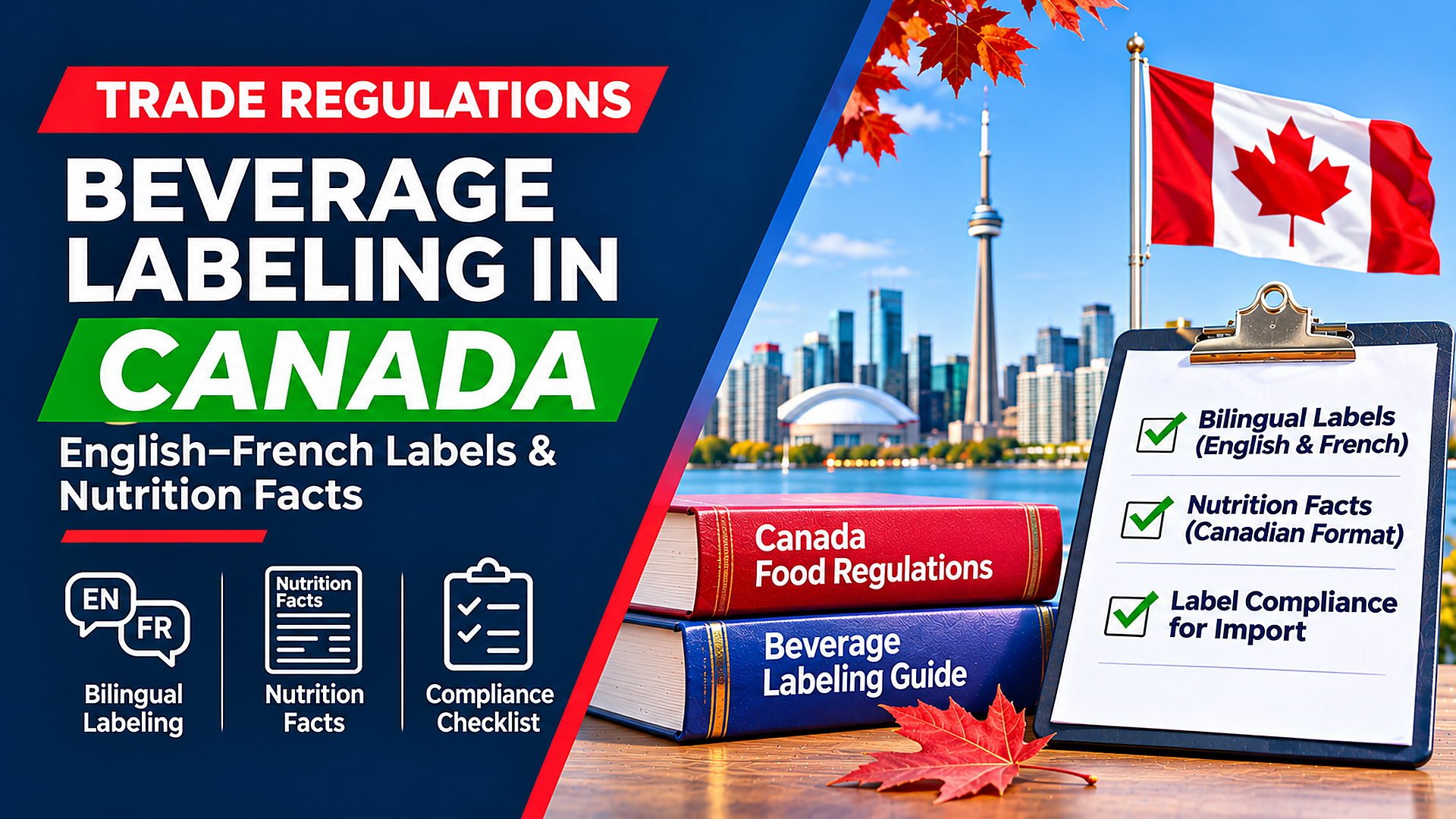
Beverage Labeling in Canada: English–French Labels and Nutrition Facts
A Canadian beverage-label checklist for importers and private-label buyers covering bilingual English–French text, Nutrition Facts, 2026 front-of-package symbols and Quebec.
13 min read
A beverage label prepared for the United States is not automatically suitable for Canada. For conventional canned or bottled drinks sold to Canadian consumers, most mandatory information must appear in English and French, and most products require a Canadian-format Nutrition Facts table. The final artwork must also address the proper food name, ingredient and allergen declarations, net quantity, responsible business, traceability and any required front-of-package nutrition symbol. Canadian Food Inspection Agency (CFIA) — bilingual food labelling and CFIA — nutrition labelling.
This guide is a practical label-review workflow for importers, distributors and private-label buyers sourcing Vietnamese fruit juice, coconut water and formulated aloe vera drinks. It distinguishes national requirements from additional rules that may apply in Quebec. It does not classify an unreviewed formula, provide approved artwork or guarantee that a particular shipment can be sold.
1. Start with the actual drink, not an existing label
Before translating any text, agree on the finished product and its Canadian retail route. Two beverages with similar front-panel graphics can have different regulatory requirements when their recipes, additives or product categories differ.
Information to confirm
Why the importer needs it
Full ingredient formula and each component
Establish the appropriate common name, ingredient order and allergen declarations
Fruit or vegetable content and whether juice is from concentrate
Review the accurate product name and any juice-related representations
Nutrition analysis and the intended serving format
Prepare the Canadian Nutrition Facts table and evaluate front-of-package rules
Added caffeine, vitamins, minerals or other supplemental ingredients
Identify any separate supplemented-food requirements
Can or bottle dimensions and print area
Choose lawful bilingual panel placement and nutrition table format
Canadian retailer, province and importer details
Check Quebec requirements and the responsible-business declaration
Lot coding, storage conditions and documented durable life
Support date marking, traceability and production approval
The framework here covers ordinary consumer-prepackaged, non-alcoholic beverages intended for retail sale. Concentrated mixes, beverages classified as supplemented foods, natural health products, foods for special dietary use and institutional-only packs may require a different assessment. CFIA — requirements for supplemented foods.
2. Put the correct common name on the principal display panel
A brand name or tropical flavour description does not replace the product's legal common name. Section B.01.006(1) of the Food and Drug Regulations and section 218(1)(a) of the Safe Food for Canadians Regulations require the appropriate common name on the principal display panel. For consumer-prepackaged food, the name normally appears in both English and French. CFIA — common name on food labels.
Some foods have prescribed standardized names under Canada's incorporated food-composition standards. Others use the commonly understood or appropriately descriptive name. This distinction matters when a buyer chooses between “juice,” a drink containing juice, and a flavoured beverage. Whether the beverage is reconstituted or has another relevant condition may also affect its naming.
Importer action: Review the formula against Canadian naming and composition rules before approving the front panel. Ask the manufacturer for the actual fruit content and processing description rather than translating the existing export-market product name word for word. Do not infer that a juice percentage printed for a different market automatically satisfies Canadian naming rules. CFIA — choosing an appropriate common name.
3. Apply the English–French requirement without assuming every exemption applies
The starting rule for consumer-prepackaged foods is bilingual mandatory information. Under SFCR section 206 and FDR section B.01.012, the common name, prescribed mandatory words and most other required label information must appear in both English and French. CFIA — bilingual food labelling, General.
A few distinctions prevent common artwork mistakes:
The name and principal place of business of the responsible company may be in one official language, but the required phrases “Imported by / importé par” and “Imported for / importé pour” must be bilingual when used. CFIA — name and principal place of business.
Defined specialty foods, local foods and test-market foods can qualify for limited language exceptions. A product does not qualify simply because it is imported or unusual to one buyer. CFIA specifically explains that most imported products do not meet the specialty-food exemption. CFIA — bilingual labelling exemptions.
A shipping carton destined only to a commercial enterprise is generally treated differently from a retail unit. When that carton itself is offered to consumers at retail, the consumer-prepackaged bilingual rules can apply. CFIA — shipping containers.
Some voluntary nutrient-content and organic claims carry their own bilingual conditions. Do not assume that English-only marketing text is acceptable because it is voluntary. CFIA — bilingual labelling of voluntary information.
English and French mandatory information may be grouped or alternated on the same surface, and certain products can use separate language panels with comparable size and prominence. The prescribed position and legibility requirements still govern. Translate meaningful product information, not just headings. A decorative French phrase near an English-only ingredient list is not a compliant substitute.
4. Declare net quantity in a suitable metric form
The net quantity of a consumer-prepackaged beverage belongs on the principal display panel, under SFCR section 221. For liquids, choose the proper metric expression and verify the product-specific rules on type size, placement and units. SI symbols such as “mL” and “L” are treated as bilingual, while words written out instead of symbols may need both official languages. CFIA — net quantity on food labels and CFIA — bilingual net quantity symbols.
Manufacturer action: Confirm the marketed fill volume and prepare a dimensioned artwork file. Importer action: Review the principal display panel at actual printed size, including curved cans, bottle labels and narrow sleeves. A compliant numeric quantity is not enough if its placement or presentation is deficient.
5. Rebuild ingredients and allergens from the formulation
Canadian ingredient declarations follow specific order and presentation rules. For most packaged foods with more than one ingredient, the list must identify ingredients and required components in descending order by weight before mixing, subject to the applicable exceptions. The list must normally appear in both English and French. CFIA — list of ingredients and allergens, referencing FDR B.01.008 and B.01.008.2.
Canada also has specific rules on how sugars-based ingredients are grouped in ingredient lists. A fruit juice concentrate used for sweetening can raise questions different from concentrate reconstituted into juice. The regulations provide exceptions, including certain fruit and vegetable juices without added sweetening agents. Do not copy sugar-grouping syntax from an American label or group every fruit ingredient without checking its function and the applicable exception. CFIA — grouping sugars-based ingredients.
Allergen control requires more than translating the word “Contains.” Canada's prescribed allergen, gluten-source and added-sulphite rules can affect coconut-containing blends, plant-based beverages, coffee drinks with milk ingredients and flavoured formulas with complex components. Added sulphites at 10 ppm or more, where the relevant conditions are met, require declaration. A “Contains” statement, when used, must identify all applicable priority allergen sources in the manner specified. A precautionary “May contain” statement is not a substitute for good manufacturing controls. CFIA — industry food-allergen resource and CFIA — ingredients and allergens.
Buyer checklist: Obtain the signed formula, supplier component breakdowns, allergen assessment and a controlled bilingual ingredients translation. Recheck the label whenever ingredients or suppliers change.
6. Prepare a Canadian Nutrition Facts table, not a translated U.S. panel
A normal Canadian NFt addresses serving size, Calories, fat and saturated/trans fat, carbohydrate, fibre, sugars, protein, cholesterol, sodium, potassium, calcium, iron and applicable daily-value declarations. The values must come from the Canadian serving and reference-amount rules, not merely from a copied U.S. serving size. Canadian legislation controls when additional information is needed. CFIA — mandatory and core nutrition information.
How to prepare the table:
Establish the finished recipe and reliable nutrient data for the actual formula.
Determine the correct Canadian reference amount and serving size, including the appropriate treatment of a single-serving bottle or a multi-serving package.
Calculate the required declarations and apply Canadian rounding rules and daily values.
Choose an approved bilingual or permitted separate-language format based on available display surface.
Inspect the printed artwork for font, borders, spacing, orientation and location.
A U.S. Nutrition Facts panel cannot simply be relabelled “Valeur nutritive.” CFIA expressly states that nutrition tables from other countries are not permitted as substitutes for Canada's prescribed NFt. CFIA — presentation and language and CFIA — NFt formats.
There are defined exemptions, not a blanket exemption for fruit drinks or imported beverages. For example, certain products whose required nutrient values can all be shown as zero, including some bottled waters, may qualify for an exemption under B.01.401(2)(a). Claims or other circumstances can cause a normally exempt product to lose that exemption. Ordinary fruit juice and coconut water should not be assumed exempt. CFIA — exemptions from the Nutrition Facts table.
7. Evaluate the front-of-package nutrition symbol under the 2026 rules
January 1, 2026 is a live compliance deadline, not a future proposal. Canada's transition period for front-of-package (FOP) nutrition symbols ended December 31, 2025. CFIA says it has not issued continuing enforcement discretion beyond that date. Goods imported, manufactured in Canada or packaged at retail before January 1, 2026 can remain for sale under the agency's stated transition approach. New imports on or after that date face the standard regulatory response process. CFIA — notice dated November 17, 2025.
Under FDR B.01.350, a prepackaged product that meets or exceeds the applicable levels of sugars, sodium or saturated fat must display the prescribed nutrition symbol unless an exemption or prohibition applies. This assessment is formula-specific. The fact that the product has no added sugar does not, by itself, answer the FOP question because naturally occurring sugars may contribute to the declared amount. Conversely, no single result can be assigned to all juices, coconut waters or aloe drinks without the actual nutrition values and exemption analysis. CFIA — front-of-package nutrition symbol.
Importer action: Ask for a signed nutrient profile and calculate the FOP outcome separately from the NFt design. Reserve front-panel space early if the symbol is required. This article does not assign an FOP symbol to an unidentified SKU.
8. Review “no added sugars” and other claims against Canadian conditions
A no-added-sugar statement is not a synonym for sugar-free. CFIA explains that the permitted “no sugar added,” “no added sugar” and “without added sugar” claims have specific criteria, including how sugars-based ingredients and sugar-raising processes are treated. Substituting fruit juice concentrate for sugar solely to sweeten a drink does not automatically satisfy the claim. The comparison-food criterion also matters. CFIA — criteria for the nutrient-content claim no added sugars.
The separate claim “unsweetened” has additional conditions, and FDR B.01.509(2) restricts its use on the principal display panel when the product carries a high-in-sugars nutrition symbol. Avoid importing U.S. claim artwork without reviewing these Canadian criteria. For private-label packaging, keep each approved claim linked to the formulation and supporting analysis. CFIA — unsweetened claim criteria.
9. Identify the responsible business, imported status and lot
Canadian labels generally identify the name and principal place of business of the person responsible for the food. For a consumer-prepackaged drink wholly produced outside Canada, section 223 of the SFCR addresses how imported status is shown when Canadian business information appears. Depending on the presentation, the label may use the foreign manufacturer's appropriate details, the Canadian company's details with geographic origin, or the bilingual “Imported by / importé par” or “Imported for / importé pour” declaration. A website URL or telephone number alone does not serve as the required physical place of business. CFIA — name and principal place of business and SFCR section 223.
Do not treat “Product of Vietnam” as universally mandatory for every beverage or as automatically sufficient without checking whether the origin and responsible-business statement meet the relevant rule. Some commodity-specific origins have additional requirements. CFIA — country of origin on food labels.
Lot identification is a separate traceability issue. Under SFCR section 92(2), covered businesses providing consumer-prepackaged food not packaged at retail generally must ensure the relevant label bears a lot code, subject to the applicable exceptions. The code may be numerical, alphabetic or alphanumeric and should enable practical identification of the batch. CFIA — selecting a lot code.
Private-label action: Confirm which legal business name belongs on the Canadian artwork, who holds importer records, and how the lot code links each case to production and distribution records.
10. Keep “best before” separate from lot traceability
For prepackaged foods with a durable life of 90 days or less, FDR B.01.007 generally requires the applicable date marking and storage instructions. Foods packed away from the retail premises use the prescribed durable-life date and storage instructions when different from normal room-temperature conditions. Food with a durable life longer than 90 days is not subject to that general mandatory best-before rule, although other requirements and truthful voluntary date claims may still matter. CFIA — date markings and storage instructions.
Many ambient-stable canned drinks are marketed with longer shelf lives, but the actual validated durable life controls. A printed production code can support traceability, while a voluntarily printed best-before date must remain accurate and follow applicable format requirements. Do not use a lot code alone to assume that every date-marking obligation is satisfied.
11. Selling in Quebec requires another language review
Federal English–French compliance is the baseline, not the entire Quebec analysis. The Charter of the French language, section 51, generally requires product inscriptions in French and restricts a non-French version from having greater prominence. Quebec's Regulation respecting the language of commerce and business contains detailed exceptions and trademark rules. Quebec charter, section 51 and Quebec regulation, sections 7.1 and 27.2.
Rules effective June 1, 2025 address certain trademarks containing generic or descriptive product terms and how their French versions are displayed. A narrow transition lasting until June 1, 2027 covers specified previously manufactured products, subject to the conditions in the regulation. It is not a general permission to launch new English-only beverage packages in Quebec. Quebec regulation, 2024 transitional section 7.
Buyer action: When the distribution plan includes Quebec, obtain a separate French-language artwork review that covers mandatory text, slogans, descriptive elements and any trademark-related language issues. Keep that approval attached to the specific artwork version.
12. Check whether a functional or caffeinated drink falls outside this pathway
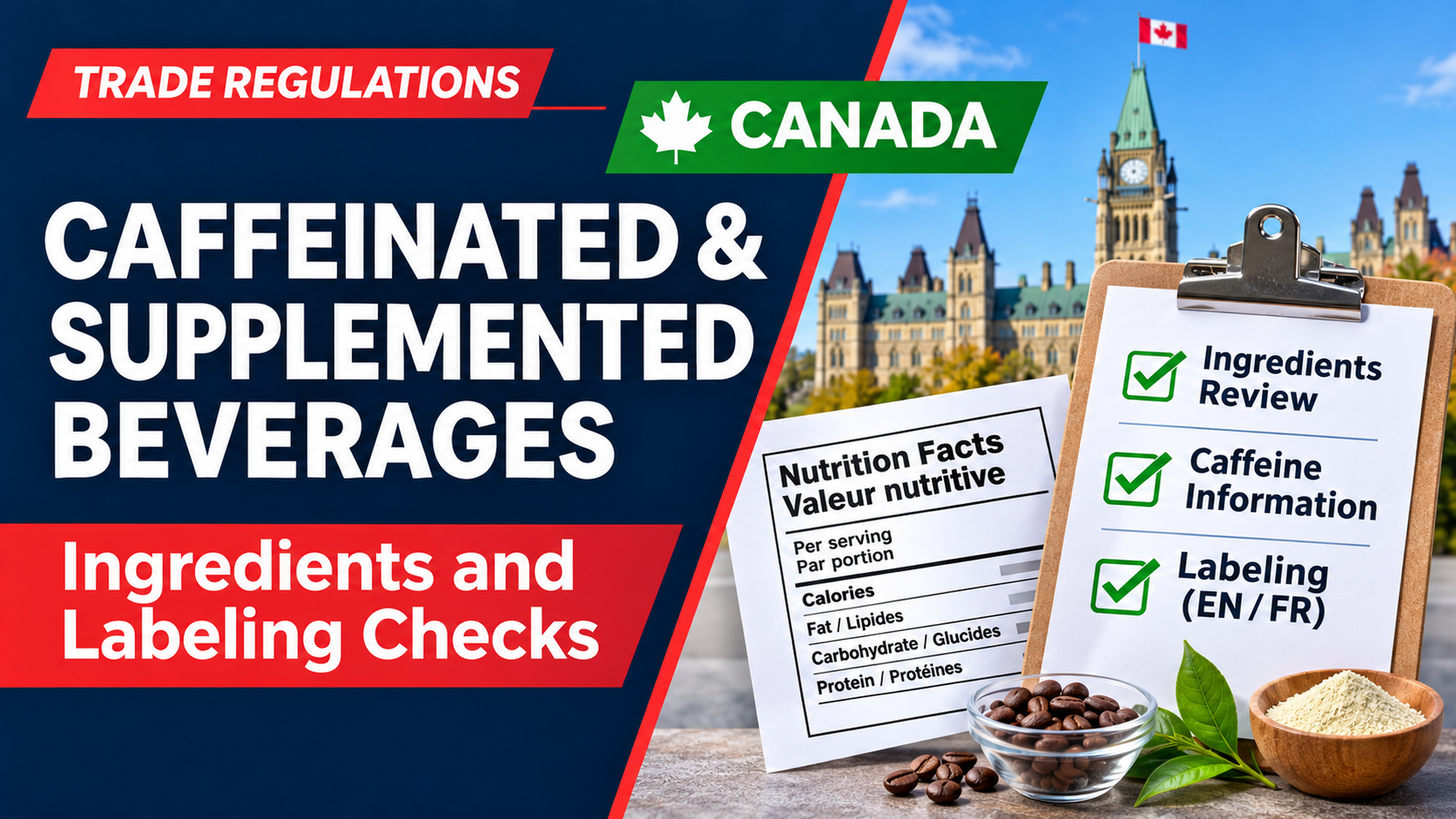
Some added caffeine, vitamins, minerals or other substances can make a product a supplemented food under the Canadian rules rather than an ordinary conventional beverage. Supplemented foods can require a Supplemented Food Facts table, specific cautionary information and, where applicable, a front-panel caution identifier. The supplemented-food transition also ended December 31, 2025. CFIA — supplemented-food labelling and Health Canada — supplemented foods regulations and compliance.
This article does not decide the classification of an energy drink or functional beverage without its ingredient quantities and intended presentation. If the recipe contains supplemental ingredients, pause the conventional NFt artwork decision until the product's Canadian regulatory pathway is determined.
A practical Canada-market artwork handoff
Use a controlled approval file for every finished SKU and label revision:
Deliverable
Manufacturing partner
Canadian importer or brand owner
Exact formula, ingredient components and allergen information
Supply and document
Evaluate against Canadian ingredient and allergen rules
Nutrient specification and shelf-life basis
Supply accurate current data
Validate Canadian NFt and FOP conclusions
Common-name and packaging brief
Provide technical product description
Approve English and French terms
Responsible-business and origin details
Supply relevant manufacturing identity
Confirm import/brand-owner statement
Print-ready artwork and lot-code placement
Implement controlled approved version
Check actual-size proofs and provincial needs
Final release record
Confirm production uses approved artwork
Authorize print and retain version history
Before a purchase order is released, compare the approved art proof with the final recipe, packaging format, current regulatory decision and retailer destination. Resolve each discrepancy by updating the controlled artwork rather than applying an unexplained translation patch. Final compliance decisions belong to the responsible Canadian business and its advisers.
Request Canada-market product and label information
Nam Viet Group supports international beverage sourcing discussions across fruit juice, coconut water and other ready-to-drink categories. Buyers planning a Canadian retail or private-label launch can share their target province, packaging format, intended product category and importer documentation requirements so the technical and artwork information can be coordinated early.
Request a Canada-market label information pack and discuss the product specifications your importer needs to review.
This is a general B2B guide to conventional consumer-prepackaged beverages, researched on November 2, 2026. Formula-specific decisions, exemptions, packaging layouts, provincial rules and final release remain the responsibility of the applicable Canadian parties. A research draft is not government certification or legal approval.
Frequently asked questions
Can I use an existing U.S. beverage label for Canada if I add a French sticker?
Not automatically. The common name, ingredients, allergens, quantity, responsible-company information and prescribed Canadian Nutrition Facts table still need a full Canadian review. An accurately applied sticker might form part of a compliant solution, but it does not cure a non-Canadian nutrition format or missing front-of-package symbol. Sources: https://inspection.canada.ca/en/food-labels/labelling/industry/bilingual-food-labelling (https://inspection.canada.ca/en/food-labels/labelling/industry/bilingual-food-labelling) and https://inspection.canada.ca/en/food-labels/labelling/industry/nutrition-labelling/presentation (https://inspection.canada.ca/en/food-labels/labelling/industry/nutrition-labelling/presentation)
Are imported tropical drinks exempt from English–French labeling as specialty foods?
Most are not. CFIA's specialty-food exemption has defined conditions, including an imported food not widely used in Canada and no readily available comparable Canadian substitute. Import status or an exotic ingredient alone does not meet those tests. Source: https://inspection.canada.ca/en/food-labels/labelling/industry/bilingual-food-labelling (https://inspection.canada.ca/en/food-labels/labelling/industry/bilingual-food-labelling)
Does every juice or coconut water require a Canadian front-of-package 'High in Sugars' symbol in 2026?
No universal answer is valid. FDR B.01.350 requires an assessment against the applicable nutrient thresholds and any full or conditional exemption or prohibition. The compliance date is January 1, 2026. The actual nutrient profile and food category determine the result. Sources: https://inspection.canada.ca/en/food-labels/labelling/industry/nutrition-labelling/fop-nutrition-symbol (https://inspection.canada.ca/en/food-labels/labelling/industry/nutrition-labelling/fop-nutrition-symbol) and https://inspection.canada.ca/en/food-labels/labelling/nutrition-labelling-regulations (https://inspection.canada.ca/en/food-labels/labelling/nutrition-labelling-regulations)
Does the Canadian importer always have to print its name in both languages?
The company name and principal place of business can generally appear in one official language. However, when the law requires 'Imported by' or 'Imported for', the accompanying expressions must appear in both English and French unless the label properly shows geographic origin under the relevant provision. Alternatives exist for foreign manufacturer details. Sources: https://inspection.canada.ca/en/food-labels/labelling/industry/name-and-principal-place-business (https://inspection.canada.ca/en/food-labels/labelling/industry/name-and-principal-place-business) and https://laws-lois.justice.gc.ca/eng/regulations/SOR-2018-108/section-223.html (https://laws-lois.justice.gc.ca/eng/regulations/SOR-2018-108/section-223.html)
Is a best-before date compulsory for every shelf-stable drink imported from Vietnam?
Not under the general federal 90-day durable-life rule. Prepackaged products with a durable life of 90 days or less generally need applicable date markings and storage instructions. Drinks with a longer validated durable life do not have a blanket best-before requirement under that rule, although voluntary dates and traceability codes must remain accurate and other requirements can apply. Source: https://inspection.canada.ca/en/food-labels/labelling/industry/date-markings-and-storage-instructions (https://inspection.canada.ca/en/food-labels/labelling/industry/date-markings-and-storage-instructions)
Does a bilingual Canadian label automatically comply with Quebec's product-language law?
No. Quebec applies additional French-language requirements to product inscriptions and certain trademarks. Changes took effect June 1, 2025. The limited inventory transition until June 1, 2027 only applies where its specific conditions are met. Sources: https://www.legisquebec.gouv.qc.ca/en/document/cs/C-11 (https://www.legisquebec.gouv.qc.ca/en/document/cs/C-11) and https://www.legisquebec.gouv.qc.ca/en/document/cr/c-11%2C%20r.%209 (https://www.legisquebec.gouv.qc.ca/en/document/cr/c-11%2C%20r.%209)
Can an energy or functional beverage use the ordinary Canadian Nutrition Facts table?
Not without determining its regulatory category. Products that meet the supplemented-food definition can require a Supplemented Food Facts table and, where applicable, a caution identifier. Assess the actual added supplemental ingredients and permitted food category first. Source: https://inspection.canada.ca/en/food-labels/labelling/industry/supplemented-foods (https://inspection.canada.ca/en/food-labels/labelling/industry/supplemented-foods)
LET'S TAKE THE NEXT STEP
Discuss your beverage requirements.
Share your market, product and preferred packaging with our team.