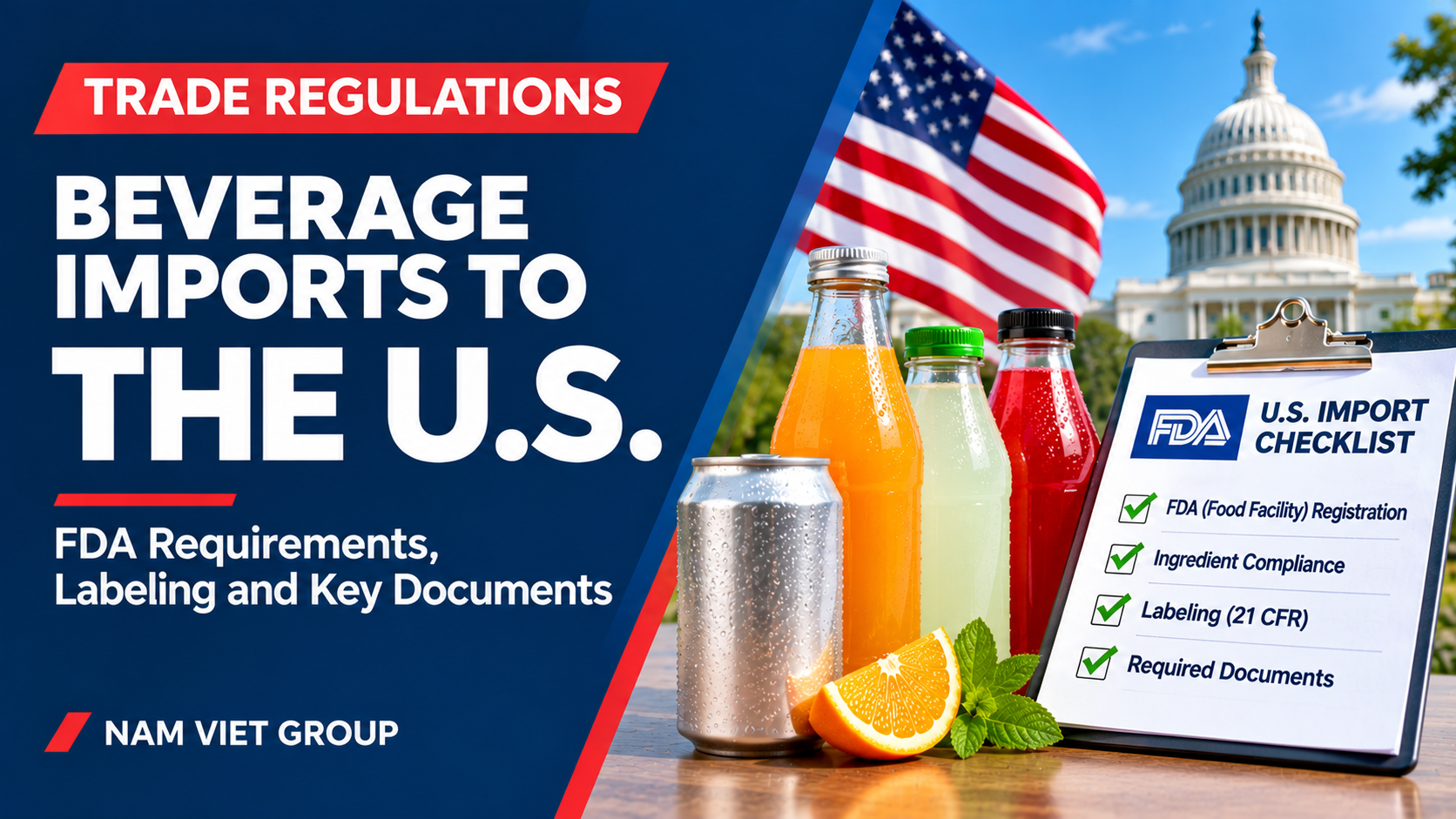
1. Identify which Vietnamese facilities must register
Under 21 CFR 1.225, the owner, operator or agent in charge of a foreign facility engaged in manufacturing, processing, packing or holding food for U.S. consumption generally must register unless an exemption applies. For a finished beverage, review the actual production, packing and holding locations, not just the exporter's trading name. A broker that does not manufacture, process, pack or hold food is not required to register merely because it arranged the sale. 21 CFR 1.225 and FDA — food facility registration questions
An important exception concerns certain foreign facilities whose food undergoes further manufacturing or processing, including packaging, at another facility outside the United States. However, this exception does not apply when the later work is limited to adding labeling or similarly minimal activity. Other exemptions exist for specified types of facilities. Do not apply an exemption solely because a company is described as a supplier or an ingredient producer. 21 CFR 1.226(a)–(g)
Buyer action: Ask the manufacturer for a facility-level process and logistics map. Identify where the beverage is made, filled, packed and stored. Confirm which facilities are subject to registration and which legal entity manages each registration.
2. Prepare the registration details and U.S. agent
FDA registration requires the facility's name and location, relevant contacts, food categories and activities, and an FDA-acceptable Unique Facility Identifier (UFI). FDA currently recognizes a D-U-N-S number as an acceptable UFI. Foreign facilities must also provide their designated U.S. agent's contact details. The regulatory fields and applicable qualifications appear in 21 CFR 1.232 and FDA's registration field guide.
The U.S. agent for a foreign facility's registration must reside or maintain a place of business in the United States and be physically present there. The agent serves as a communication contact with FDA. This role is not automatically the customs importer of record, the FSVP importer or the person who files Prior Notice. Those roles should be allocated separately. FDA — Foreign Food Facility Inspection Program Q&A
Registration and renewal are normally submitted electronically through FDA Industry Systems. Paper submission requires an FDA-granted waiver. FDA does not charge a fee to register or renew a food facility and does not require a private registrar. A commercial U.S.-agent service may charge its own service fee, which is not an FDA registration fee. FDA — registration and renewal notice, FDA — paper registration rules and FDA — third-party fees
Buyer action: Obtain registration details through a secure channel and ask the facility to confirm that the address, UFI and U.S. agent still match its actual operations. Do not present a registration number as an FDA certificate approving a finished beverage.
3. Check the 2026 renewal and registration changes
2026 deadline: Facilities required to renew must complete the FDA biennial renewal during October 1–December 31, 2026. FDA says a registration not renewed by December 31, 2026 will be considered expired. An ordinary registration update is different from the biennial renewal and does not replace it. FDA — September 29, 2026 constituent update and FDA — biennial renewal user guide
Outside the normal renewal cycle, 21 CFR 1.234 generally requires an update within 60 calendar days after a change in previously submitted registration information. A change of ownership is handled differently: the former owner must cancel the prior registration within the specified period and the new owner must submit a new registration. 21 CFR 1.234(a)–(b)
Buyer action: For purchases shipping during the 2026 renewal period or shortly afterward, request confirmation that the relevant facility has completed its 2026 renewal. Recheck the facility and agent data when production moves or ownership changes.
4. Decide whether Prior Notice is required for the shipment
FDA's Prior Notice rules cover food imported or offered for import into the United States for use, storage or distribution. The scope specifically includes trade and quality-control samples, foods moving through the United States to another country, and food entering a U.S. Foreign Trade Zone. Therefore, a small commercial sample shipment is not exempt just because it is free of charge. 21 CFR 1.277(a)
Exceptions in 21 CFR 1.277(b) include food carried by an individual for that person's own use, qualifying homemade personal gifts, and limited other categories. These exceptions should not be applied to ordinary shipments of finished beverages intended for resale. 21 CFR 1.277(b)
Prior Notice information is required for each imported article of food under the relevant regulatory provision. Do not assume that one generic declaration covers every distinct beverage in a mixed container. Identify product descriptions, quantities and manufacturing details for the specific articles included. 21 CFR 1.281(a)
5. Select the filing channel and assign the submitter
Under 21 CFR 1.278, any person with knowledge of the required information may submit Prior Notice. A submitter can also use a separate transmitter. In practice, the U.S. importer and customs broker should agree who prepares, transmits, checks and retains the confirmation. The manufacturer's U.S. agent does not automatically acquire that task. 21 CFR 1.278
FDA describes two main electronic routes: the CBP Automated Broker Interface within the Automated Commercial Environment (ABI/ACE), or FDA's Prior Notice System Interface (PNSI). The chosen system and the type of entry affect the workflow. FDA — Filing Prior Notice
Buyer action: Before shipping, put the filing channel, submitter, customs broker, responsible importer and escalation contact on the same shipment checklist. Confirm who will send the FDA Prior Notice confirmation number to the carrier when necessary.
6. Follow the arrival deadline for each transport mode
FDA must receive and confirm Prior Notice within the minimum periods specified in 21 CFR 1.279(a):
For ordinary non-mail entries, Prior Notice submitted through ABI/ACE cannot be filed more than 30 calendar days before expected arrival. PNSI submissions cannot be filed more than 15 calendar days in advance. FDA starts the applicable notice period when it confirms the submission for review, not simply when a broker begins preparing the form. 21 CFR 1.279(b) and (d)
These are regulatory minimums, not recommended targets for last-minute filing. Build in time to resolve product-code errors, missing manufacturer information and changed shipment details.
7. Gather the data before booking the shipment
For commercial food arriving other than by international mail, 21 CFR 1.281(a) identifies the required fields and conditions. Build a pre-filing data packet that includes:
- The responsible submitter and transmitter details, when different.
- CBP entry type and the entry identifier, if available.
- The complete FDA product code, accurate common or market name, estimated quantities and applicable lot identifiers.
- The manufacturer identity, including registration information where required or an allowed alternative with the reason the registration number is not supplied.
- FDA country of production, shipper and country from which the article is shipped.
- Importer, owner and ultimate consignee details as applicable to the entry.
- Anticipated port, date and time of arrival, carrier, mode and available container or transport references.
- Any country in which that article of food has been refused entry.
Some fields and alternatives depend on the circumstances. The legal rule, rather than a generic document checklist, controls what is actually required. For example, lot identifiers are specifically required when another applicable FDA provision requires them. 21 CFR 1.281(a)(5)–(18)
Manufacturer action: Supply consistent facility identity, product descriptions, quantities and processing information. Importer or broker action: Map those details into the applicable FDA product codes and entry records. A commercial invoice or bill of lading is useful supporting evidence but does not, by itself, replace Prior Notice.
8. Handle changes and FDA confirmation correctly
A Prior Notice confirmation means FDA has received a submission for review. It does not mean the details have been independently validated, that the food is approved, or that the shipment has been released. FDA may inspect or take further action when the food is offered for import. FDA — Prior Notice guidance and FDA — Importing Human Foods
If information changes after confirmation, consult 21 CFR 1.282 before deciding whether to submit a replacement notice. For ordinary non-mail articles, the rule excludes changes solely to the stated quantity, anticipated arrival information and planned shipment information from its mandatory resubmission trigger. Other changes to required data generally trigger resubmission. Affected parties should still reconcile operational changes with the broker so the shipment can be matched correctly. Do not automatically resubmit every late vessel ETA adjustment, and do not ignore a change to the manufacturer or product identity.
Buyer action: Keep the original confirmation, record the reason for any replacement, and match the FDA filing to the final shipping documents. Confirm FDA and CBP release status separately before allowing distribution.
9. A separate 2026 rule for international mail
This guide focuses on commercial beverage freight. International mail has different Prior Notice timing and information rules. A September 25, 2025 final rule added a mail-service name and mail-tracking-number requirement beginning October 1, 2026. FDA subsequently announced that it does not intend to enforce those two new mail-information elements until May 1, 2027. That is an enforcement policy, not a cancellation of the underlying Prior Notice obligation and not an exception for ocean containers. FDA — Prior Notice update and FDA — October 2026 enforcement guidance.
Businesses sending beverage samples by post must still assess the applicable Prior Notice and shipping requirements.
Pre-shipment checklist for beverage importers
- Identify the finished beverage, facility network and actual U.S. market use.
- Confirm which manufacturer, packer and holding facilities require FDA registration.
- Obtain current facility details, UFI and relevant U.S.-agent contact information securely.
- Verify 2026 biennial renewal, if applicable, and any material registration updates.
- Confirm the U.S. importer, customs broker, Prior Notice submitter and transmitter.
- Determine whether the shipment or sample qualifies for a specific Prior Notice exemption.
- Prepare FDA product codes, quantities, manufacturer data, arrival plans and entry references.
- Submit through the agreed channel in the correct filing window and retain confirmation.
- Reconcile any post-confirmation changes using 21 CFR 1.282.
- Confirm separate food-safety, labeling, customs and FDA release requirements.
FDA Food Facility Registration and Prior Notice are essential checkpoints, but they are not substitutes for product-specific food-safety and labeling compliance. For example, fruit juice and coconut water can raise Juice HACCP issues, while other beverage formulations may require a different importer safety pathway. FDA — Importing Human Foods
Discuss your U.S. beverage sourcing requirements with Nam Viet Group
Nam Viet Group works with international beverage buyers on product and manufacturing requirements across categories such as fruit juice, coconut water and ready-to-drink beverages. Before finalizing an order for the United States, share the product category, intended packaging, U.S. sales channel and data requirements from your importer or broker. This makes it easier to align product specifications and the documentation process early.
Planning a beverage import from Vietnam? Contact Nam Viet Group to discuss the product specifications and export information your U.S. buyer needs for its own compliance review.
This article summarizes selected U.S. federal rules for commercial packaged non-alcoholic beverages. Exact obligations, exemptions and product admissibility depend on the actual goods and the responsible parties. It does not replace a shipment-specific review by the U.S. importer or qualified adviser.