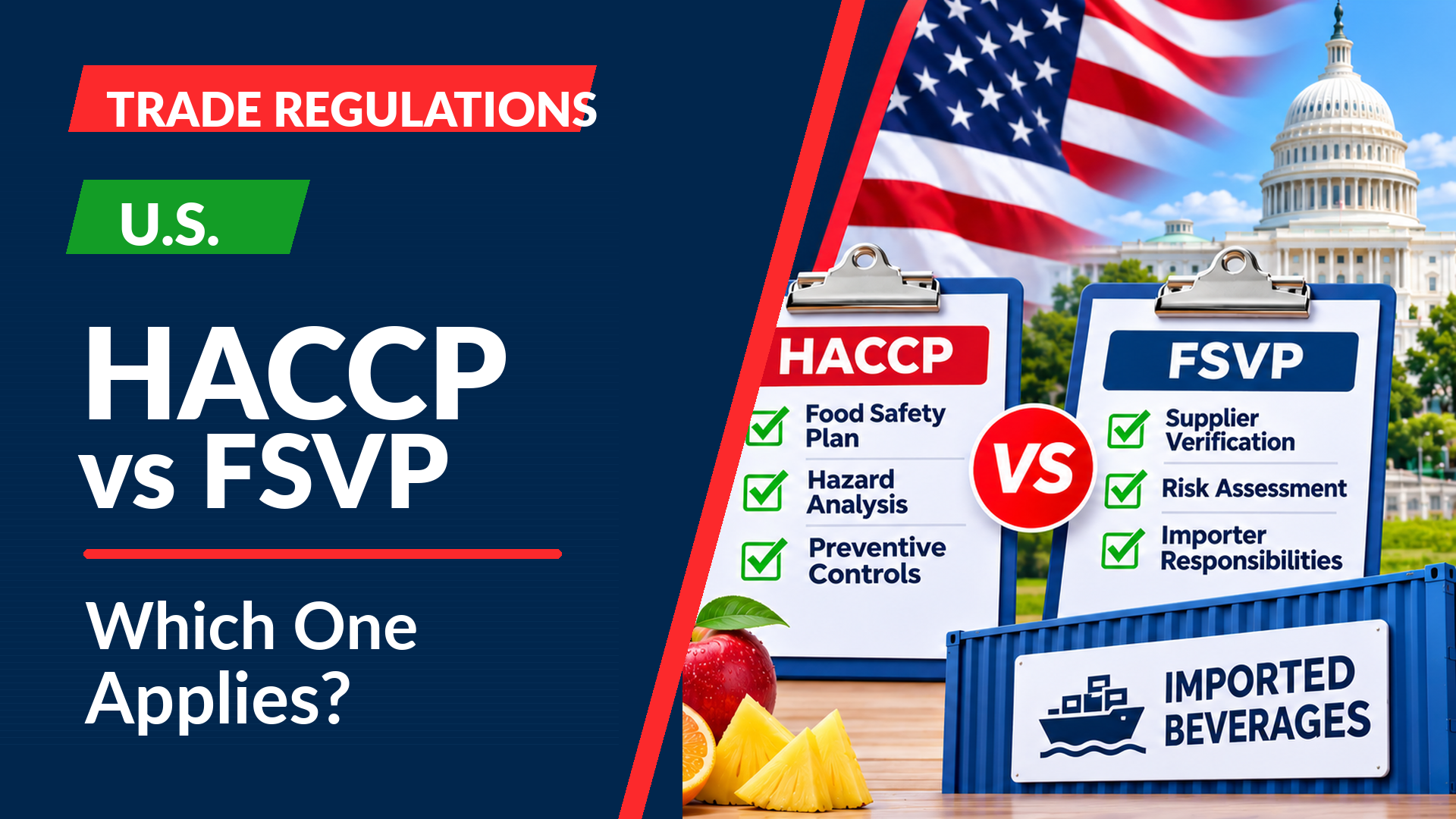
For beverages shipped from Vietnam to the United States, Juice HACCP and the Foreign Supplier Verification Program (FSVP) are not interchangeable choices. The rule depends on what is actually imported. The Vietnamese processor addresses applicable production controls, while the responsible U.S. importer handles the relevant import verification. A finished juice drink may follow a different route from its juice ingredient. FDA Juice HACCP Q&A
1. Classify the imported product first
FDA's Juice HACCP rule in 21 CFR Part 120 covers juice sold as juice and juice or puree used as a beverage ingredient. FDA specifically treats coconut water and liquid extracted as coconut milk as juice. But a diluted nectar or carbonated juice drink is not automatically a Part 120 finished juice product. FDA applicability Q&A and Juice HACCP coverage
Product arriving in the U.S. | Main importer route | Important distinction |
|---|---|---|
Juice, juice concentrate or extracted coconut water | Juice HACCP importer checks, 21 CFR 120.14 | FSVP exemption depends on the foreign processor complying with Part 120 |
Diluted juice drink or fruit nectar | Generally FSVP for the finished beverage | Its juice or puree ingredient must have been produced under Juice HACCP |
Tea, coffee or other non-juice drink | Generally FSVP | Check other food-specific exemptions if relevant |
The decision concerns the imported item itself, not merely a marketing name or whether a manufacturer holds a generic HACCP certificate. FSVP scope, 21 CFR 1.501
2. When Juice HACCP governs imported juice
For qualifying juice, the foreign processor must meet applicable Part 120 requirements, including hazard analysis and controls. Under 21 CFR 120.14, the U.S. juice importer must either use a qualifying active FDA agreement route or implement written verification procedures with product specifications and affirmative steps. The importer must retain English-language records of those steps. 21 CFR 120.14
21 CFR 1.501(b)(1) excludes juice from FSVP only where the foreign supplier is required to comply with and is complying with Part 120. Noncompliant juice does not become acceptable simply by substituting an FSVP document. FDA's 2003 Q&A also clarifies that importers of finished diluted juice beverages are not Juice HACCP importers under 120.14. FSVP exemption and FDA imported-juice Q&A
3. When the finished beverage falls under FSVP
An imported nectar or juice-containing carbonated beverage generally falls under FSVP for that finished beverage, even though its juice ingredient was made under Juice HACCP. FDA explains that producing a diluted beverage is different from processing its juice ingredient. Do not apply the juice-only importer exemption to the whole mixed drink. FDA Juice HACCP coverage and FDA imported-juice Q&A
For foods within FSVP, the U.S. importer ordinarily conducts or evaluates hazard analysis, assesses supplier risks, approves suppliers, performs appropriate verification and maintains records. Some categories and qualified arrangements have modified requirements or exemptions, so the importer must apply the precise rule rather than assume every beverage needs an identical audit package. FDA FSVP key requirements
4. Assign importer responsibilities and supporting evidence
For FSVP, the importer is ordinarily the U.S. owner or consignee at entry, or a designated U.S. agent or representative if there is no U.S. owner or consignee. This person need not be the Customs importer of record. The Vietnamese manufacturer provides evidence, but does not become the FSVP importer just by supplying documents. FDA FSMA FAQs, FSVP.1–3
Before production, the buyer should request a formula and process summary showing whether the product is juice, concentrate, extracted coconut liquid or a formulated drink. Then agree on the applicable supplier evidence, which may include hazard analysis, HACCP records, process validation or supplier-verification results according to the route. A certificate alone does not replace the importer's legally required activities. 21 CFR 120.14 and FDA FSVP FAQs
5. Check the route before dispatch
- Identify the exact beverage being entered and distinguish finished product from juice ingredients.
- Confirm the U.S. buyer or agent legally responsible for the applicable import verification.
- For qualifying juice, obtain evidence supporting Part 120 processing and the importer's 120.14 procedures.
- For FSVP-covered drinks, confirm the importer has assessed and approved the relevant supplier.
- Match ingredient, process, lot and shipping records to the imported product before dispatch.
Discuss U.S.-market product specifications with Nam Viet Group. Share your beverage type, formula category and packaging requirements so the manufacturing team can coordinate technical documentation with your importer.
This guide addresses federal importer verification for conventional commercial beverages. FDA facility registration, Prior Notice, labeling and any product-specific rules remain separate obligations.
Frequently asked questions
Can I use FSVP instead if my imported juice supplier does not comply with Part 120?
No. The FSVP exemption for juice assumes the foreign supplier is required to comply with and is complying with Part 120. A supplier failure is not resolved by choosing the FSVP pathway instead. 21 CFR 1.501(b)(1) (https://www.govinfo.gov/content/pkg/CFR-2025-title21-vol1/html/CFR-2025-title21-vol1.htm)
What if I import ingredients to manufacture compliant juice in the United States?
Under 21 CFR 1.501(b)(2), some imported raw materials or other ingredients used to manufacture juice can fall outside FSVP when the importer complies with Part 120 for the juice it makes. This is a conditional ingredient exemption, not a blanket rule for finished drinks. FSVP scope (https://www.govinfo.gov/content/pkg/CFR-2025-title21-vol1/html/CFR-2025-title21-vol1.htm)
Does a supplier HACCP or third-party certification automatically satisfy the importer?
No. Juice importers need the written procedures, affirmative steps and records specified in 21 CFR 120.14. FSVP importers must carry out or properly review the activities applicable to their program. Certificates can be supporting evidence, not an automatic substitute. Juice importer rule (https://www.govinfo.gov/content/pkg/CFR-2025-title21-vol2/html/CFR-2025-title21-vol2.htm) and FSVP FAQs (https://www.fda.gov/food/food-safety-modernization-act-fsma/frequently-asked-questions-fsma)