Can an approved Arabic sticker replace a redesigned pack?
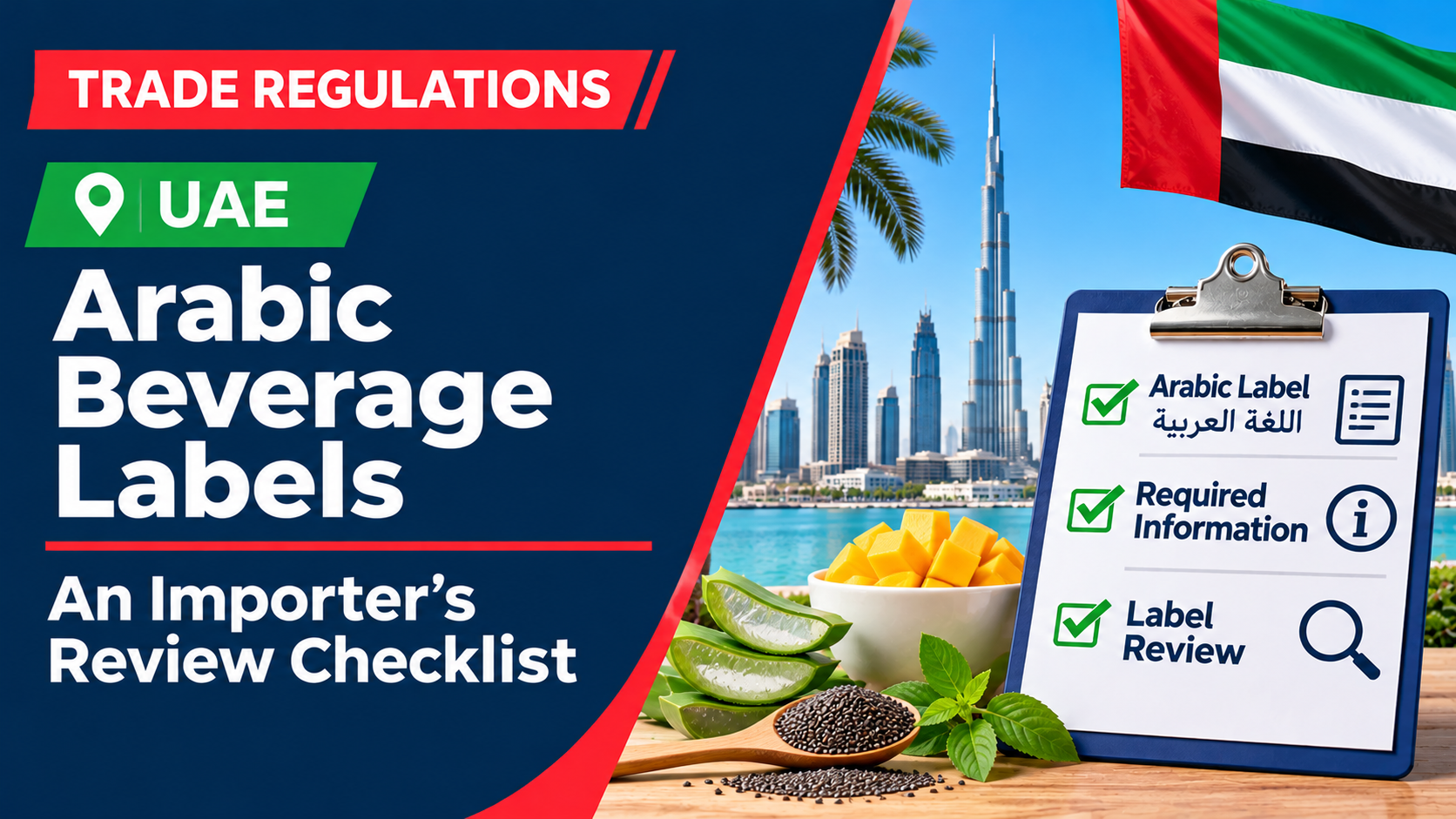
Arabic-only or Arabic–English retail labels are possible. The U.S. government guide reports that translation stickers are accepted when assessed and approved by UAE authorities, and that stickering should be completed before export, rather than on arrival. Submit actual bilingual artwork or sticker proof for label assessment.
Stickers must not hide required information or contradict original artwork. Importantly, the guide states that production and expiry dates belong on the original manufactured label, not solely on a later Arabic sticker. Confirm date format and shelf-life details separately for each pack, particularly when supplying both cans and bottles.
How should product names, claims and digital labels be checked?
Translate the actual food description, not a more attractive category. For example, coconut water, mango juice and an aloe beverage can have different ingredient declarations and permitted claims. Compare Arabic and English versions against the final formulation, including sweeteners, preservatives, pulp and any special storage condition. Hold the artwork if a claim lacks product evidence.
The GSO 9:2022/Amd1:2025 amendment, approved by GSO on 22 April 2025, adds a rule allowing electronic codes as a supplement, not a replacement for the written label. It also addresses misleading presentation. This GSO approval date alone does not prove the UAE implementation date. Ask the importer to confirm the locally applicable version before treating these clauses as the final artwork standard.
Who handles label assessment in Dubai?
The Dubai Municipality Food Safety Department lists Apply to Register and Assess a Food Item and, separately, Apply to Release Imported Food Consignments for Sale in Local Market. They are distinct steps. The importer should confirm authorised filers, required label images and whether each pack variation needs assessment.
Dubai's service workflow should not be assumed to apply unchanged across every emirate. Before production, confirm the destination emirate, importer details and competent authority. If the authority requests revisions, reconcile them with the manufacturer's master artwork before shipping rather than relying on a port-side correction.
What should the buyer verify before approving printing?
- Fix the exact destination and product. Identify the UAE emirate, importer, beverage category and consumer pack size.
- Request the evidence pack. Obtain the final formula, ingredient statement, nutrition data, origin and proposed batch/date coding.
- Check Arabic against English. Review the product name, applicable warnings, ingredient names, storage statements and claims with a qualified Arabic reviewer.
- Validate the physical pack. Examine legibility, sticker positioning and original production/expiry marks on a real-size proof.
- Submit for local assessment. Have the importer confirm the UAE technical-standard edition and relevant municipality process before ordering labels.
- Freeze the approved version. Record artwork revision, pack format and importer sign-off, then release printing only when material questions are resolved.
Discuss UAE-market beverage label information with Nam Viet Group. Share your destination emirate, product category, ingredients and draft pack artwork so our team can coordinate available specifications for your importer's assessment.
This is a conventional retail-beverage label checklist, not an approval of a specific SKU, food supplement or customs shipment.